Evidence Engine: An MCP Server That Shows Its Reasoning
A real, deployed MCP server whose product is the evidence trail, not the verdict. Its first tool plans astrophotography shoot windows and returns the weighted reasoning behind every call.
- Role
- Design Engineer
- Timeline
- 2026
- Tools
- TypeScript, Node, Hono, MCP SDK, Fly.io
- Team
- Solo
MCP Server Registration was a design case study about how organizations register and discover MCP servers at scale. This is the other half of that story: actually building and shipping one.
The Problem
Most AI tools hand back a verdict and hide the reasoning. You get an answer with no way to see what drove it, which is exactly backwards for a decision you’re accountable for. “Evidence over authority” is easy to put on a slide. I wanted a tool where it was structural, where every response carries the weighted evidence that produced it, not as an explanation bolted on afterward but as the actual product.
The test case is deliberately unglamorous and checkable: planning an astrophotography shoot. Whether tonight is good for the Milky Way is a real question with real inputs, cloud cover, moon phase, and light pollution, that either align or they don’t. You can check the call against the actual sky.
The Process
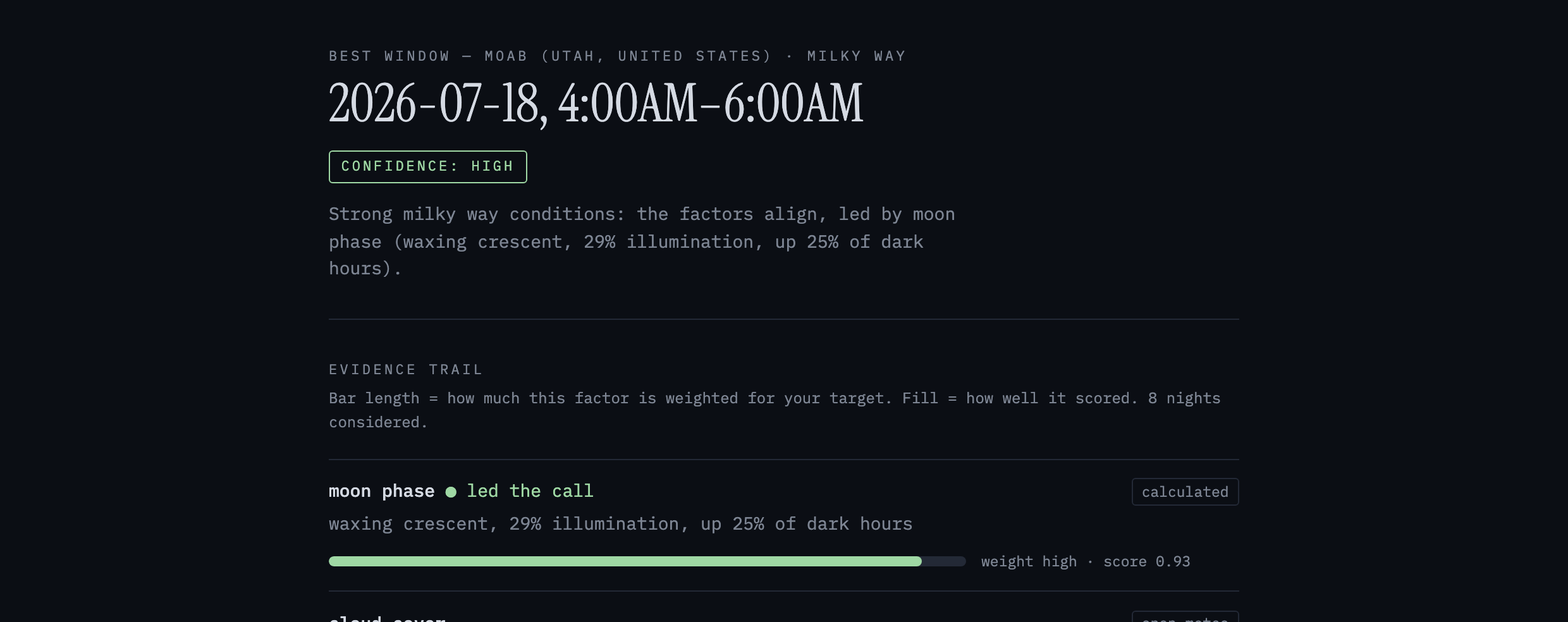
The tool is Night Window. Ask it to plan a shoot window for a location and it returns a recommendation plus the full evidence ledger behind it: every factor with its weight, its score, its data source, and whether it helped or hurt.
Bar width = how much this factor weighs for the target · fill = its score · red = a blocking factor that caps confidence
Same location, same tool, four different skies. Watch what the last two do. A perfect new moon under heavy cloud, and a perfectly clear new-moon night in Manhattan, both get pulled down, but by different factors, and the ledger names which one.
Under all of it is one small reasoning engine that has no idea it’s an MCP server. Three thin layers sit on top of the same core: the MCP protocol endpoint, a plain REST route, and the web demo. The protocol is a transport, not the product, so the logic worth writing never had to know which one it was answering.
 Explore the live, interactive demo
The Decision
The first version scored each factor from zero to one and combined them with target-dependent weights. It was wrong in a specific, instructive way: a clear-sky, new-moon night in Manhattan scored “high” for the Milky Way, because two great factors outvoted one catastrophic one. A weighted average will happily average away a dealbreaker.
So the scoring has a second rule on top of the average. Any single factor below a threshold caps the overall confidence, no matter how strong the rest are. Good weather can’t outvote bad light pollution. The ledger flags that factor in red and names it the blocking one. That is the whole thesis in miniature: the number alone can lie, and the evidence is what keeps it honest.
A few other calls worth naming:
- Moon phase is calculated, not fetched. You can’t order a full moon from an API, so position and illumination come from astronomy math (a truncated Meeus series), unit-tested against known 2026 new and full moon dates.
- Light pollution is a deliberate shortcut. A static curated dataset of dark-sky sites and metros, not a live satellite lookup. It’s documented as a cut with a stated path to the real thing, rather than pretended away.
- It degrades instead of failing. If the weather API times out, the tool still answers on moon and light pollution alone, and lowers its own confidence to say so.
The Outcome
- Deployed and live on Fly.io, reachable three ways from one server: the MCP endpoint, a REST API, and the web demo
- Connectable as a real remote MCP server in Claude Desktop or Claude Code, where the evidence trail returns with every tool call
- A reasoning eval suite that pins the tool to fixed scenarios (real lunar dates, injected weather) and checks it flags the right blocking factor every time
- Scale-to-zero hosting: it sleeps when idle and wakes on demand, which keeps costs near zero without pretending the server isn’t real
Reflection
The honest version: the astrophotography domain is a vehicle. The point wasn’t a better shoot planner, it was a working example of a tool that argues its case instead of asserting it. That said, I do photograph the night sky, and the first time Night Window told me a clear night was still a bad Milky Way call because the moon was up, and it was right, the evidence-over-authority idea stopped being a slogan and started being something I’d rely on.
It also closes a loop I’d only drawn on paper. MCP Server Registration argued about where MCP capability should live across an organization. This one is the small, real proof that I can build the thing those systems are meant to hold.